


Harraps Guide To Famous London Graves
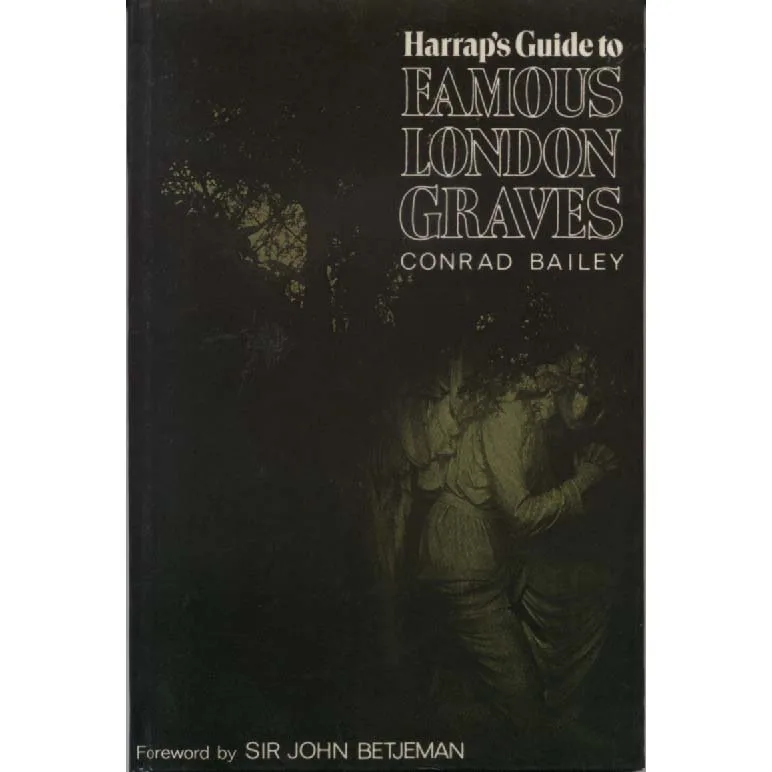
Publisher: George G Harrap
Format: Hardback
ISBN: 024552374X
Harrap’s Guide to Famous London Graves (1975) by Conrad Bailey
George G. Harrap | ISBN: 024552374X
Condition: Good
As sold by Crappy Old Books
London is full of attractions: palaces, parks, museums, theatres, shops that sell things you didn’t know existed and now apparently need. But if you’re in the mood for a different kind of sightseeing — quieter, greener, significantly more permanent — then Harrap’s Guide to Famous London Graves is your slightly mischievous companion.
Because yes, London tourism can absolutely include cemeteries, and frankly it should. These are some of the city’s most atmospheric open-air archives: lanes of stone and ivy, names that ring bells, names you’ve never heard of, and names you suddenly realise you should have heard of. And the joy of this book is that it turns all that into a proper, practical mission. Not just “wander about and feel gothic,” but: here’s who’s where, and how to find them.
Conrad Bailey’s guide is from 1975 — which means it comes with that wonderful pre-digital confidence that you, a map, and a sense of purpose can locate anyone, even in a cemetery the size of a small village. No GPS. No phone. No “Are we sure this is the right Spencer?” Just you, a gate, a path, and the slow realisation that Victorian Londoners took death extremely seriously and memorials extremely personally.
What you get here is part guidebook, part cultural treasure hunt. It points you towards graves of the celebrated, the infamous, the influential, and the oddly beloved — writers, artists, performers, politicians, reformers, eccentrics. People whose names still hum in the background of London life, and people who once mattered enormously and now rest quietly while joggers go past with headphones on.
And there’s a delicious irony to it all: the city that never stops moving also contains these calm, fenced-off islands where time has stopped completely. You can step out of the roar of traffic into a place where the loudest thing is a blackbird and the most dramatic event is a squirrel disrespecting someone’s obelisk.
It’s also a surprisingly good way to understand London. The cemeteries are where stories collect: not just of individuals, but of whole eras — epidemics, wars, social shifts, changing fashions in grief, the rise of public figures, the fall of old families, the Victorian passion for carving entire novels into stone. You don’t just find famous people; you find the city’s past arranged in rows, with moss and subtitles.
This copy is Good, meaning it’s been used as intended: carried, consulted, perhaps taken on a slightly damp afternoon pilgrimage to Highgate or Kensal Green. It’s ready for a new reader — the kind who enjoys history with a map, doesn’t mind a bit of drizzle, and is perfectly comfortable admitting that “grave tourism” is both deeply respectful and faintly hilarious as a concept.
From Crappy Old Books: because London’s greatest residents aren’t all in museums. Some are in quiet corners behind iron gates, and this guide is basically your invitation to go and say hello — softly.
Keep browsing: See more Travel books Other books by Conrad Bailey
